
Limestone Parole and Probation Compared
Parole is discretionary release from TDCJ to serve the remaining sentence under supervision. Mandatory supervision is another statutory path, based on calendar time, good-conduct time, eligibility, and review. Both are administered through the TDCJ Parole Division after release. Probation is imposed by a judge and administered by a Community Supervision and Corrections Department, or CSCD. A probationer may never have entered TDCJ.
| Question | Parole or mandatory supervision | Probation |
|---|---|---|
| Who orders it? | BPP acts within state release law | The sentencing court |
| Who supervises? | TDCJ Parole Division | The CSCD named in the court record |
| Starting record | TDCJ and BPP status or release record | Judgment and community-supervision order |
| How it ends | Official discharge or sentence completion | Court or CSCD completion and discharge record |
| Wrong first search | A county roster alone | TDCJ current-inmate search |
The distinction determines where to call and what a record proves. A Limestone County Jail bond release is not parole. A TDCJ transfer is not release. A court’s probation order shows a supervision term, while the jail’s release entry answers when physical custody ended.
- Parole
- Conditional release from state prison before the full sentence ends.
- Community supervision
- Texas’s statutory term for probation administered under a court order.
- Absconder
- A person a supervising authority alleges stopped reporting or cannot be located.
- Discharge
- Formal completion of the sentence or supervision obligation in the responsible agency’s record.
Verify Limestone Post-Release Supervision
Use the case number and custody type before relying on a name. Similar names are common, and a narrow enforcement registry does not list every person under supervision. The safest workflow joins the sentencing record to the state or CSCD record.
- Identify the sentence. Obtain the cause number, judgment, offense, sentence date, and any TDCJ or SID number lawfully known.
- Separate prison release from probation. A TDCJ sentence points to Parole Division and BPP channels. A community-supervision judgment points to the named CSCD.
- For parole, ask TDCJ. Send supervision or location questions to io@tdcj.texas.gov, or request an existing Parole Division record through pia@tdcj.texas.gov.
- For probation, read the docket. Confirm the term, start and end dates, modifications, revocation entries, and discharge order with the sentencing court and CSCD.
- Confirm the current status. Distinguish active supervision, an alleged violation, a pending warrant, revocation, and final discharge.
TDCJ’s current inmate search covers people still incarcerated in a TDCJ facility. It is not a full archive of discharged people. TDCJ IVSS may show custody, parole, or mandatory-supervision events, but county bond releases belong to county records. The Limestone release-record paths help trace the custody event before the supervision check begins.
Limestone Parole Contact Channels
Do not assume the nearest parole office owns a case. TDCJ assigns supervision, and the research did not verify a Limestone-specific field office address that should be published as the responsible office for every person. Ask TDCJ which field office supervises the named parolee. This avoids sending private details to the wrong place.
Texas parole records and status
Supervision or location questions: io@tdcj.texas.gov
Parole Division public records: pia@tdcj.texas.gov
BPP review questions: bpp-pio@tdcj.texas.gov
Pre-vote status: 844-512-0461
Post-vote release processing: 512-406-5202
For probation, start with the signed Limestone County sentencing order. The order should identify the CSCD responsible for the case. Ask that office about public start and end dates, modifications, revocation entries, and discharge. Neither a parole line nor the TDCJ offender search is the right first channel for a person sentenced only to probation.
Limestone Parole Review Has No Calendar
Texas does not publish a conventional person-by-person calendar of public initial parole hearings. The ordinary process is an administrative file review followed by sequential voting, not a courtroom-style hearing open on a set public date. Revocation hearings and BPP open meetings are different proceedings. They should not be presented as an initial-release calendar.
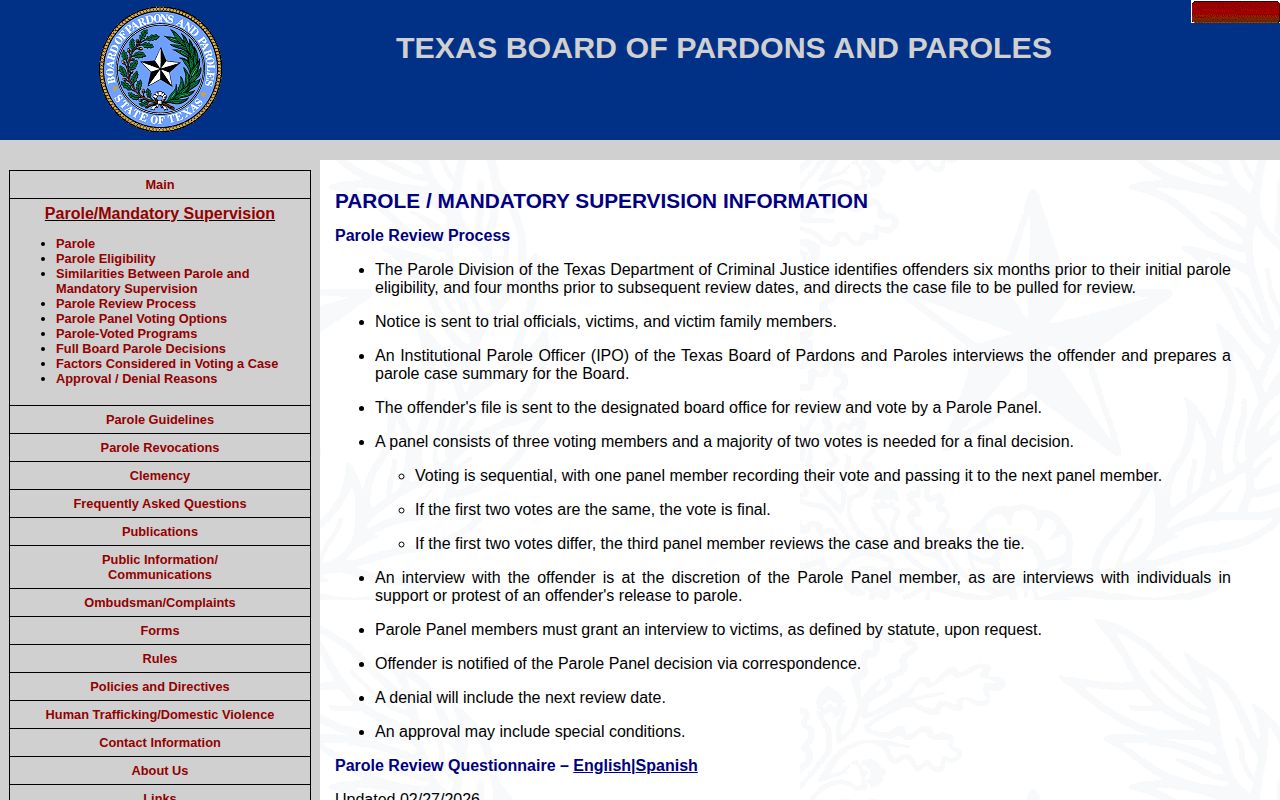
The official BPP review process says the Parole Division identifies a case six months before initial eligibility and four months before a later review date. An Institutional Parole Officer prepares a summary. A three-member panel votes in sequence. Two matching votes decide; otherwise, the third member breaks the tie. The person receives correspondence, and a denial gives a next-review date.
A named person’s result can be checked through TDCJ parole-review information while a current record is available or by calling 844-512-0461 with identifying information. A favorable vote may still be reconsidered if new information arrives. After an approval, 512-406-5202 addresses release processing. Neither response guarantees the moment a person will walk out of a unit.
The matched BPP screenshot provides a visual reference for the state’s file-review process. Read the official process before interpreting a review date.
Read Limestone Parole Vote Codes
BPP outcomes carry more detail than “granted” or “denied.” FI-1 generally means release when eligible. FI-2 identifies a specified future month and year. Other favorable codes may require a treatment or education program, and RMS concerns mandatory supervision. None is an actual release timestamp.
Denial codes include NR for a next review and SA for serving the balance, subject to applicable mandatory-supervision review. Combined codes such as CU/NR and CU/SA carry their own official meanings. DMS is denial of mandatory supervision. Use the current BPP vote glossary instead of guessing from initials.
Reviews are generally annual after NR, but some Government Code §508.149(a) categories and specified cases can receive a later review as far as five years, with at least one year. Eligibility is controlled by Government Code §508.145 and offense-date rules. A review, vote, planned date, physical exit, supervised term, and discharge must be recorded as distinct milestones.
Limestone Warrants and Absconders
A warrant or absconder notation means the authority alleges noncompliance and seeks custody. It is not a new conviction. It also does not show where the person is now. Verify the identity, issuing authority, current warrant status, and any later court or agency action before describing the result.
The public TDCJ Sex Offender Absconder Search is especially narrow. It does not contain all parole absconders, every person on a registry, all warrants, or all released people. The Texas DPS Sex Offender Registry is also limited to people subject to registration. It may show identification and location data after release, but it does not prove the date or reason for a Limestone jail or prison release.
How Limestone Supervision Ends
Parole supervision ends through an official discharge or other controlling agency action. Probation ends through the court and CSCD process reflected in the case and discharge records. Simply reaching an expected date does not substitute for the final entry. Revocation, modification, an amended judgment, or a new case can alter the sequence.
For parole, ask TDCJ for the supervision and discharge fields tied to the correct person. For probation, obtain the public discharge order or completion record from the sentencing case. A nondisclosure or expunction question is separate and category-specific under Texas law. Release, completion of supervision, and record clearing are not automatic synonyms.
Keep the judgment, release entry, supervision record, and discharge document in date order. That sequence prevents a parole eligibility date from being mistaken for release and a projected end date from being reported as completed supervision. If records conflict, ask the office that created the disputed field to correct its entry. The court controls its orders, TDCJ controls state supervision records, and the Sheriff controls county booking and release fields.
BPP vote language also affects the path to supervision. FI-1 points to release when eligible, while FI-2 identifies a future month and year. Program-conditioned approval codes can require completion of a named treatment or education track before release processing advances. RMS concerns mandatory supervision. A favorable code therefore may describe a pathway with unfinished steps rather than a date on which custody ended. Read the current BPP glossary, then confirm post-vote status with the Parole Division.
A denial has its own timeline. NR sets another review, while SA generally directs the person to serve the balance subject to any mandatory-supervision consideration that still applies. The BPP vote-options material says reviews are generally annual after NR, but specified statutory categories may receive a next review between one and five years. That next review date is not a discharge date. It marks when another administrative review may begin.
Mandatory supervision must remain separate from parole even though the TDCJ Parole Division supervises both in the community. Texas Government Code Chapter 508 sets eligibility, exclusions, and review rules. A person can be ineligible, can receive a discretionary denial, or can reach a projected discharge path when release is not approved. Request the agency field that names the actual status rather than collapsing all supervised release into the word parole.
For Limestone probation, the signed judgment is equally important. It identifies the term the judge imposed and provides the basis for locating the responsible CSCD. Later docket entries may show a modification, a motion to revoke, a revocation order, or discharge. A motion is not the same as a final order. Follow the entries in date order and obtain the signed document that controls the current status.