
Limestone Projected Versus Actual Release
TDCJ uses the exact field name Projected Release Date. It is a forecast made from sentence data, offense date and type, eligibility rules, time credits, and Texas Board of Pardons and Paroles action. A Scheduled Release Date may appear later in processing. Neither field is the same as a release timestamp. Even a scheduled date can move before the person exits a unit.
A pretrial detainee at Limestone County Jail has not yet received a sentence to calculate. Bond action, a court order, dismissal, transfer, or later judgment may end or change custody. For that person, ask about the active booking and read the court docket. A sentenced county inmate has a judgment and jail-credit calculation. A state prisoner has a TDCJ calculation. Mixing these systems produces false dates.
Find a Limestone Inmate Release Date
Start with the custody segment, not a broad name search. Limestone County Jail, the adjacent contract detention center, TDCJ, BOP, and ICE maintain different records. A county booking transferred to TDCJ remains in custody. A handoff to USMS or ICE also is not a community release.
- Identify the custodian. Use the booking agency, case number, TDCJ or SID number, federal register number, or A-number. Compare at least two identifiers.
- For TDCJ custody, search the current record. Enter the exact last name and first initial, or use the seven-digit TDCJ number or SID at the TDCJ Inmate Search.
- For county time, obtain the judgment. Ask the sentencing clerk for the signed judgment and jail-credit entries, then ask the Sheriff for its calculated release record.
- Check parole action separately. A review date, favorable vote, and physical release are distinct milestones.
- Verify after the date passes. Obtain an affirmative agency record. Disappearance from a current-only search is not enough.
TDCJ says its online data is updated on working days and is at least 24 hours old. The system includes only people currently incarcerated in a TDCJ facility. A no-result response therefore does not establish discharge. The broader Limestone County released-inmate search paths explain how to follow county, state, and federal custody after a person leaves a live locator.
TDCJ Limestone Release-Date Channels
The online search accepts a last name plus at least a first initial, a TDCJ number, or a SID. Optional gender and race fields can narrow a common name. Last-name matching is exact, so prior names and spelling matter. Open a result only after matching more than the name. The detail can show the unit, offenses, sentence information, projected release information, and parole-review information.
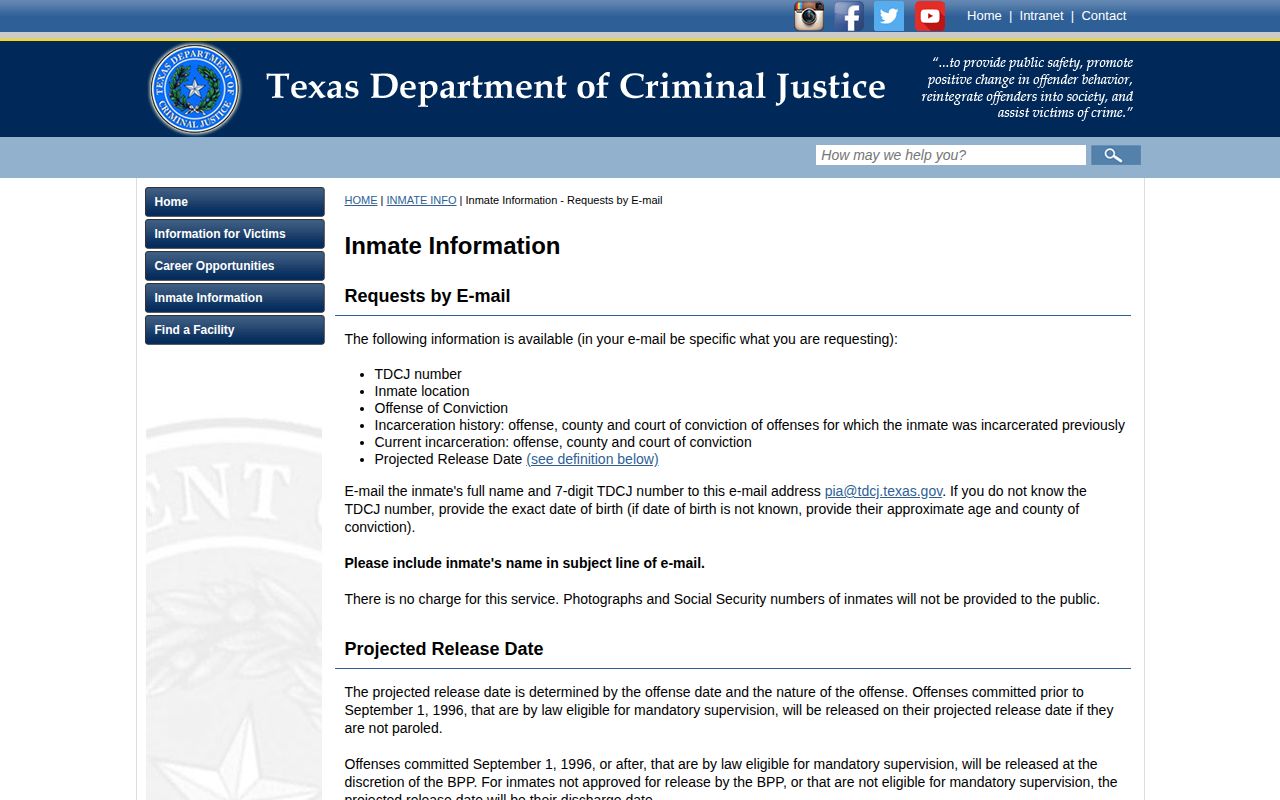
If the current screen fails or a documented response is needed, email TDCJ inmate information at pia@tdcj.texas.gov. Put the incarcerated person’s name in the subject. Include the seven-digit TDCJ number, or exact birth date when the number is unknown, and specify Projected Release Date. Approximate age and county of conviction can help. TDCJ lists this ordinary email service as free and says it can provide location, conviction offense, incarceration history, and the projected date.
Telephone routes depend on the stage. General locator lines are 936-295-6371 and 800-535-0283. Before a parole vote, BPP status is available at 844-512-0461. After a favorable vote, the Parole Division release-status line is 512-406-5202. The official telephone page lists weekday service from 8 a.m. to 5 p.m. and asks for an exact birth date when no TDCJ or SID number is known.
The matched manifest image shows TDCJ’s official explanation of its projected-release field and email request route. Review the source instructions before sending identifying details.
Limestone Good Time Calculations
Texas Government Code §498.003 governs good-conduct time. Classification and time-earning status affect accrual. Good time is a privilege, not a vested right, and disciplinary action can cause forfeiture. A later restoration may be allowed in some settings, but it should never be assumed. These credits interact with state rules; they do not simply subtract a fixed share from every sentence.
Government Code §508.147 describes mandatory-supervision timing when calendar time plus accrued good-conduct time equals the term, subject to exclusions in §508.149 and discretionary review. For an eligible offense committed before September 1, 1996, TDCJ explains that a person not paroled is released on the projected date under the then-applicable mandatory-supervision framework. For later eligible cases, BPP may deny mandatory supervision on statutory findings. If release is not approved, or the person is not eligible, the projected date may be the discharge date.
- Good-conduct time
- A state credit tied to classification and conduct. It can affect eligibility or mandatory-supervision calculations but does not erase calendar time already imposed.
- Parole eligibility
- The point when BPP may review a person. It is not an exit date or promise of approval.
- Mandatory supervision
- A statutory form of supervised release based on eligibility, calendar time, credits, and review rules.
- Discharge
- Completion of the controlling sentence or supervision obligation, as recorded by the responsible agency.
No Texas 85 Percent Rule
Texas has no blanket rule requiring every state prisoner to serve 85 percent of a sentence. That shorthand should not be used for a Limestone County case. Under Government Code §508.145, the serious-offense group linked to Code of Criminal Procedure art. 42A.054 generally reaches parole eligibility after actual calendar time, without good-time credit, equal to one-half of the sentence or 30 calendar years, whichever is less. Subsection-specific minimums and offense-date rules can change that result.
This distinction matters. Good time, mandatory supervision, parole eligibility, a BPP vote, scheduled release, physical release, and final discharge are separate events. Eligibility only opens a review path. A favorable vote can include conditions, programs, or a later month, and TDCJ warns that new information may cause reconsideration. The statute and official computation control, not a percentage repeated on an unofficial site.
Why Limestone Release Dates Change
A displayed date is built from records that can later change. Some changes shorten a forecast, while others delay it or redirect custody. Ask which factor changed and request the amended source record.
| Factor | Effect on the date | Best confirming record |
|---|---|---|
| Jail-credit correction | Changes credited calendar time | Judgment, commitment, or corrected calculation |
| Concurrent or stacked sentences | Changes how terms run together | Sentencing judgments and TDCJ calculation |
| Disciplinary forfeiture | May remove accrued good time | TDCJ disciplinary and time-credit record |
| Amended judgment | Can revise sentence terms or credits | Signed court order |
| Detainer or new sentence | May cause transfer or continued custody | Detainer, warrant, or receiving-agency record |
| BPP vote or program | Can set conditions or a later release path | Official vote code and release-status response |
| Calculation audit | Corrects an agency data error | Updated TDCJ or Sheriff calculation |
A county sentence must be read through the judgment, the Sheriff’s time calculation, and Texas law. Do not apply a TDCJ projection mechanically to Limestone County Jail. Likewise, a federal BOP date does not calculate a Texas sentence.
Confirm Limestone Actual Release
After the projected day, look for a release, parole, mandatory-supervision, discharge, or transfer entry. For state custody, TDCJ IVSS can report custody and supervision events, while Parole Division channels can address supervision and post-vote processing. For county custody, call Limestone County Jail at 254-729-3278 and request the booking/release field that gives the date, time, code, and transfer notation.
IVSS-Counties may help with a county event if Limestone participates, but the portal warns that a person no longer in custody may disappear and that its information is not an official record. Save an alert and then obtain the agency entry. If a record says TDCJ, ICE, USMS, or another county, follow that custodian. The words “no longer shown” remain the accurate description until an affirmative record identifies what happened.
Travel plans should never rest on the online date alone. TDCJ advises contacting the unit before a planned pickup because public data can lag and dates can change. For a county release, confirm with the jail rather than the state prison system. If the date passed but custody continues, ask whether the cause is a detainer, another sentence, a court order, a program condition, or a calculation update. Request the existing record that supports the answer.
A projected date also cannot reveal where someone goes next. Release to parole means supervised community custody. Transfer to another county, TDCJ, USMS, or ICE means custody continues under a different authority. A full discharge has a separate record. Use the exact agency term so a requestor does not act on a false assumption about the person’s status.
The offense date can change which mandatory-supervision framework applies. TDCJ explains that an eligible offense before September 1, 1996 follows the earlier scheme when the person is not paroled. For an eligible offense on or after that date, BPP discretion applies. If BPP does not approve mandatory supervision, or if the person is ineligible, the projected field may instead point toward discharge. That distinction cannot be resolved from sentence length alone.
Parole eligibility has another calculation. For the serious-offense group tied to Code of Criminal Procedure art. 42A.054, Government Code §508.145 generally uses actual calendar time equal to one-half of the sentence or 30 years, whichever is less, without applying good time to that eligibility calculation. Subsection minimums and offense-date rules still matter. Eligibility only permits review; it does not set physical release.
A BPP review adds more steps. The Parole Division identifies a case before the review point, an Institutional Parole Officer prepares a summary, and a panel votes. Approval may include a program, condition, or later month. Release-plan approval and final processing can follow. Each event may change the expected path without creating an actual exit record.
Calculation records should be checked when the displayed date shifts. Corrected jail credit, concurrent or consecutive sentence treatment, an amended judgment, disciplinary forfeiture, restored credit where allowed, a new sentence, or an agency audit can alter the forecast. Ask for the updated calculation and the order or agency entry that caused the revision. A screenshot of an older date cannot override the current official record.